

Selling a Hoarder House In Texas
If you are reading this, you are probably tired. You may have just walked through a parent’s house for the first time in years. You may have just gotten the call from the hospital. You may have just opened the door of a home you inherited and felt your stomach drop.
Take a breath. You are not alone. And you have more options than you think.
LEAP Properties has helped Texas families sell hoarder homes across the state since we began.
Quick Answer: What Most Families End Up Doing
If you are short on time, here is the short version.
Most families with a hoarder house in Texas end up choosing one of two paths. The first path is to clean the house, fix the worst damage, and list it with a real estate agent. This usually nets the most money, but it takes several months and costs $15,000 to $50,000 out of pocket. The second path is to sell the house as-is to a cash buyer like LEAP. This closes in one to three weeks, and costs nothing out of pocket. The trade-off is a lower sale price.
The “right” answer depends on four things: how bad the house is, how much time you have, how much money you have to put into repairs, and how much energy you have.
Part 1: Hoarding Disorder
In 2013, the American Psychiatric Association added Hoarding Disorder to the DSM-5 as its own diagnosis. Before that, it was lumped in with obsessive-compulsive disorder. The change was important. Hoarding is not laziness. It is not a moral failing. It is not “your dad just being stubborn.”
People with hoarding disorder feel intense distress at the thought of throwing things away. The objects feel like extensions of themselves. A broken toaster might represent “I am resourceful.” Stacks of newspapers might represent “I will read these when I have time.” A box of a deceased spouse’s clothes might represent love itself. Forcing the items into a dumpster does not solve the problem. It often makes it worse.
The Clutter Hoarding Scale
Professional organizers and biohazard companies use the Clutter Hoarding Scale created by the Institute for Challenging Disorganization. It runs from Level 1 to Level 5. Knowing where the house falls helps you plan.
| Level | What It Looks Like | Selling Reality |
|---|---|---|
| Level 1 | Mild clutter. All doors and stairways work. No safety issues. | Sells normally on the open market with a deep clean. |
| Level 2 | More clutter. One major exit blocked. Light pet odor or mildew. | Sells on market after a thorough cleanout and minor repairs |
| Level 3 | Visible clutter outside. Narrow walking paths. One bedroom or bathroom unusable. Some pest activity. | More expensive repairs needed to bring to market or lenders refuse to finance. |
| Level 4 | Structural damage. Sewage or plumbing failure. Strong odor. Active rodent or insect infestation. | Won’t work for FHA, VA, and conventional loans. Biohazard remediation needed before listing. Will probably still only sell to a flipper or investor on market without a large renovation. |
| Level 5 | Severe structural failure. Human or animal waste. No working bathroom or kitchen. Often condemned. | Either major renovation project or cash sale. |
The Health and Safety Risks
Before you spend a single weekend “starting to clean,” know what you might be walking into.
Hoarder homes are extremely dangerous fires. The U.S. Fire Administration has flagged hoarded homes as a leading cause of preventable fire deaths in older adults. Blocked exits, piles of paper, and disabled smoke alarms turn small kitchen fires into fatal blazes. Fire departments report longer rescue times because they cannot get through the front door.
Floors can collapse. Stacks of books, magazines, and water-damaged paper get heavy. Basements and second floors in Texas homes were not designed for that load. Mold grows fast in our humidity. Black mold can cause real respiratory problems. Rodents leave droppings that, when stirred up, can carry hantavirus.
Please do not enter a Level 3 or higher home without N95 masks, gloves, sturdy boots, and a partner. If there is any sign of human or animal waste, do not enter at all. Call a licensed biohazard remediation company. Texas requires licensed mold remediators for any job over 25 contiguous square feet under Texas Department of Licensing and Regulation rules. This is not a job for a regular cleaning crew.
Part 2: Real Options for Selling
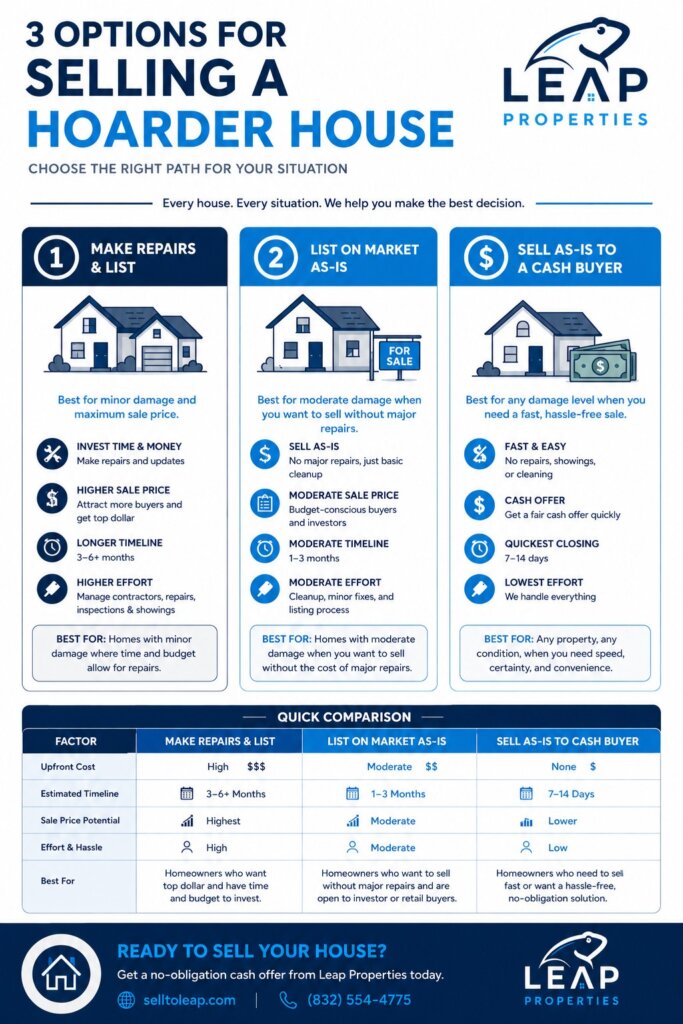
Every family with a hoarder house in Texas has three main options, (people could turn it into a rental property, or do for sale by owner, but these options are taken so rarely, that it isn’t worth discussing) We will walk through each one honestly, including when it is not the right call.
Option 1: Full Renovation
This is the path most people imagine first. You hire a cleanup company. You replace flooring and drywall. You repaint, re-stage, and put it on the MLS. In a strong market, you get top dollar. For Level 1 and Level 2 homes, this often works. For Level 3 and higher, it gets expensive fast.
Clear it Out → Clean It → Fully Renovate → Sell It
Effort
Very high. Managing a full renovation requires coordinating contractors, inspections, timelines, material selections, and unexpected issues that often arise with hoarder properties.
Cost
Highest overall cost. Expenses depend heavily on the severity of the hoarding, structural damage, contamination, and the level of finishes used during the remodel.
Timeline
Typically 4–6 months, and sometimes longer if major repairs are needed.
Profit Potential
Highest potential profit. A fully renovated home generally sells for top market value because buyers can move in immediately without repairs.
Risks
This option carries the highest level of risk, including:
- Contractors going over budget or performing poor work
- Delays from permits or inspections
- Hidden damage discovered during renovation
- Liability if someone is injured on the property
- Market conditions changing before the house sells
- Carrying costs such as taxes, insurance, utilities, and loan payments while the home sits vacant
When It Makes Sense
- You have available cash or financing
- You have time to manage a large project
- You are comfortable handling contractors and unexpected issues
- The property is in an area where renovated homes sell for a premium
When It May Not Make Sense
- You want a quicker or less stressful solution
- You do not have the financial resources for a major project
- The property has extensive damage or contamination
- You do not want the risk of cost overruns or delays
Option 2: List “As-Is” on the Market
This is the middle path. You skip a full renovation. You do a cleanout a light repairs to make it safe to enter, take photos, and list it on the MLS as-is.
Clear It Out → Basic Cleaning/Minor Repairs → Sell It
Effort
Moderate. Most sellers still need to coordinate cleanup crews, junk removal, and basic safety repairs so buyers can walk through the home.
Cost
Moderate cost depending on the condition of the property.
Examples:
- Mild hoarding in a newer home: approximately $3,000–$5,000
- Severe hoarding with biohazards in an older home: approximately $20,000–$30,000+
Timeline
Usually 1–3 months.
Profit Potential
Moderate profit potential. You will not achieve the same sale price as a fully renovated home, but you may still capture strong value without taking on a full remodel.
In some situations, heavily distressed homes will only be viable to investors rather than traditional retail buyers because they won’t be able to get a traditional loan.
Risks
- Paying upfront cleanup costs
- The property may still scare away many buyers
- Inspection issues can arise during escrow
- Buyers may request additional repairs or credits
When It Makes Sense
- The house needs cleanup but not a full renovation
- You want a balance between speed and maximizing value
- You are willing to spend some money preparing the property for sale
When It May Not Make Sense
- The home has major structural or contamination issues
- You do not want to coordinate contractors or cleanup crews
- You need to sell very quickly
Option 3: Sell to a Cash Buyer
Sell the House As-Is
Effort
Lowest effort. In most cases, you do not need to clean, repair, or remove anything from the property.
Cost
Lowest cost. There are typically no cleanup, repair, or holding costs.
Timeline
Often 7–14 days from agreement to closing.
Profit Potential
Lowest overall sale price compared to the other options. Cash buyers typically purchase homes at a discount because they are taking on the cleanup, repairs, risk, and holding costs themselves.
Risks
Lowest overall risk because:
- No renovation costs
- No contractor management
- No cleanup expenses
- No uncertainty about listing the home
- No risk of the house sitting on the market
When It Makes Sense
- You need to sell quickly
- You do not want to manage repairs or cleanup
- The property has severe damage or biohazards
- You inherited the property and live out of town
- You want certainty and convenience
When It May Not Make Sense
- Maximizing sale price is your top priority
- You have the time and resources to improve the property before selling
Part 3: Texas Law — What You Should Know
This section is the part that competitor articles skim over. We are going to walk you through it carefully, because the Texas legal rules around selling a hoarder house can save you (or cost you) tens of thousands of dollars. None of this is legal advice. Always run your specific situation past a Texas real estate attorney.
The Texas Seller’s Disclosure Notice (TREC OP-H)
Texas Property Code Section 5.008 requires sellers of one-to-four-unit residential properties to give the buyer a written Seller’s Disclosure Notice. The Texas Real Estate Commission (TREC) publishes the standard form (currently the OP-H). The seller must check boxes about the condition of the roof, plumbing, electrical, HVAC, structural, and known defects. There is a section for environmental issues, including mold, termites, rodents, and water damage.
Here is the part most sellers do not realize: selling “as-is” does not waive the disclosure requirement in Texas. You still have to fill out the form honestly. If you knew about the mold and you did not disclose it, the buyer can come after you for fraud after closing, even years later.
Some exemptions to Section 5.008 exist. The most common one for hoarder houses is when the home is sold by an executor or administrator of an estate who never lived in the house. In that case, the executor may not be required to provide the disclosure, but they still cannot make false statements. Always check with your probate attorney. A direct cash buyer like LEAP will tell you exactly what disclosures we expect at closing, so there are no surprises.
Code Violations and Municipal Liens
Every major Texas city — Houston, Dallas, Austin, San Antonio, Fort Worth, El Paso — has a property maintenance code. When neighbors complain or a city inspector spots a hoarder home, the city can issue citations. If the violations are not cured, the city can mow the yard, haul off junk, or, in extreme cases, demolish the structure, then bill the owner. Unpaid bills become municipal liens on the property.
Liens attach to the title. They follow the property until they are paid, and they will block any sale. Before you do anything else, pull a title commitment from a Texas title company. They will identify any liens or judgments. A clean title is the single most important thing for a smooth closing.
If you discover liens, do not panic. Most title companies can negotiate payoffs, and some cities will reduce the balance for a fast sale. Cash buyers are often willing to take the lien hit out of their offer if the math still works.
Why Lending is an Issue With Hoarder Homes
The HUD Handbook 4000.1 requires that any home financed with FHA or VA money meet “minimum property requirements.” Inspectors look for a working roof, working heat and water, no exposed wiring, no active leaks, no peeling lead paint in pre-1978 homes, and no major structural issues. Hoarder homes routinely fail on at least three of those criteria.
Conventional loans run on Fannie Mae and Freddie Mac guidelines. While the standards are slightly more flexible, the appraiser still flags obvious habitability issues. Once the appraisal report says “subject to repairs,” the buyer cannot close until the repairs happen. With a hoarder home, that means the seller usually has to fund the repairs before the deal can move forward.
This is the single biggest reason cash buyers dominate the hoarder-home market. It is not because cash buyers are predatory. It is because the lenders simply will not show up.
Part 4: A Realistic Cleanout Cost Guide for Texas
If you decide to clean and list, you need realistic numbers. Texas has a strong network of biohazard and hoarder cleanout companies. The big national names (Bio-One, Steri-Clean, Aftermath, Spaulding Decon, Address Our Mess) all have Texas offices. Local crews often beat them on price.
Cleanout pricing by Clutter Hoarding Scale level
These are typical 2025-2026 ranges for a 1,500 to 2,000 square foot Texas home. Larger homes scale up roughly with square footage.
| Level | Typical Cleanout Cost |
|---|---|
| Level 1 | $1,000 – $3,000 |
| Level 2 | $2,500 – $6,000 |
| Level 3 | $4,000 – $12,000 |
| Level 4 | $8,000 – $20,000 (often plus biohazard fees) |
| Level 5 | $15,000 – $40,000+ |
Most hoarder cleanout companies charge by the labor hour ($60 to $120 per worker per hour) plus dumpster and disposal fees. A single 30-yard dumpster runs $400 to $700 in major Texas metros, and a serious cleanout often needs three to six. Many companies offer a fixed-price quote after a free walkthrough, which is what we recommend if you go this route.
Biohazard remediation
Once human or animal waste, blood, or decomposition is involved, the job becomes biohazard work. Texas does not require a state biohazard license, but reputable companies follow OSHA bloodborne pathogen standards and dispose of waste through licensed medical waste haulers. Costs run $1,500 to $10,000 on top of the regular cleanout.
Homeowners insurance sometimes covers biohazard cleanup when there has been an unattended death. Always file a claim before paying out of pocket. The insurance language to look for is “trauma scene cleanup” or “ordinance and law” coverage.
Mold remediation
Texas humidity makes mold one of the most common hidden problems in hoarder homes. Texas Department of Licensing and Regulation rules require a licensed mold remediation contractor whenever the affected area is greater than 25 contiguous square feet. Costs typically run $15 to $30 per square foot of affected area, with a $2,000 minimum at most companies.
If mold has spread into the HVAC system, expect duct cleaning ($500 to $2,000) on top of the remediation. Severe cases may require replacing the entire system.
Pest control
Texas hoarder homes typically have at least three pest issues at once. Roaches, rodents, and either bedbugs or termites are the usual suspects. A full pest treatment runs $300 to $1,500. If termite damage is in the framing, structural repairs add another $3,000 to $15,000.
What you usually find behind the walls
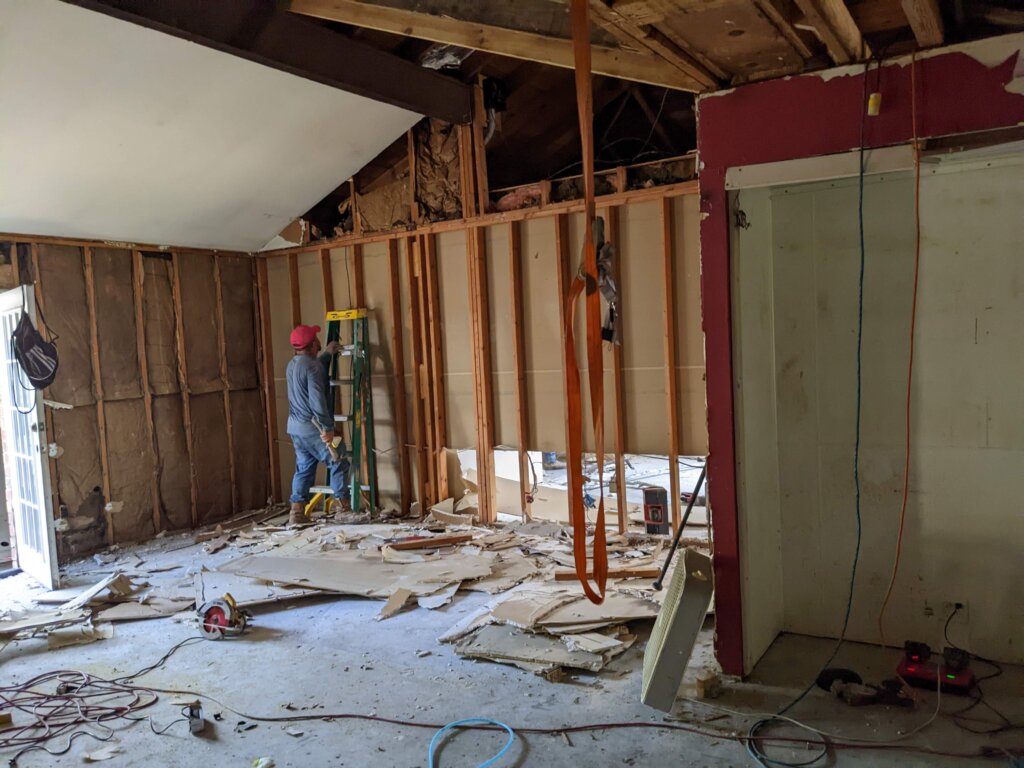
The cost ranges above assume the cleanout reveals a generally sound home. Sometimes it does not. Common surprises in Texas hoarder homes:
- Subfloor damage from pet urine. Plywood subfloors absorb urine and rot. Replacement runs $5 to $12 per square foot. A full primary suite floor can hit $8,000.
- Failed HVAC systems. Filters that have not been changed in five years destroy the unit. New systems for an average Texas home run $7,000 to $14,000.
- Compromised wiring. Rodents chew insulation. A partial rewire is $4,000 to $10,000.
- Slab leaks or foundation issues. Texas clay soil moves. A leak under the slab can run $3,000 to $8,000 to repair.
The reason cash offers come in below ARV is precisely this list. We assume some surprises, because in our experience there are always surprises.
Part 4: Case Study:
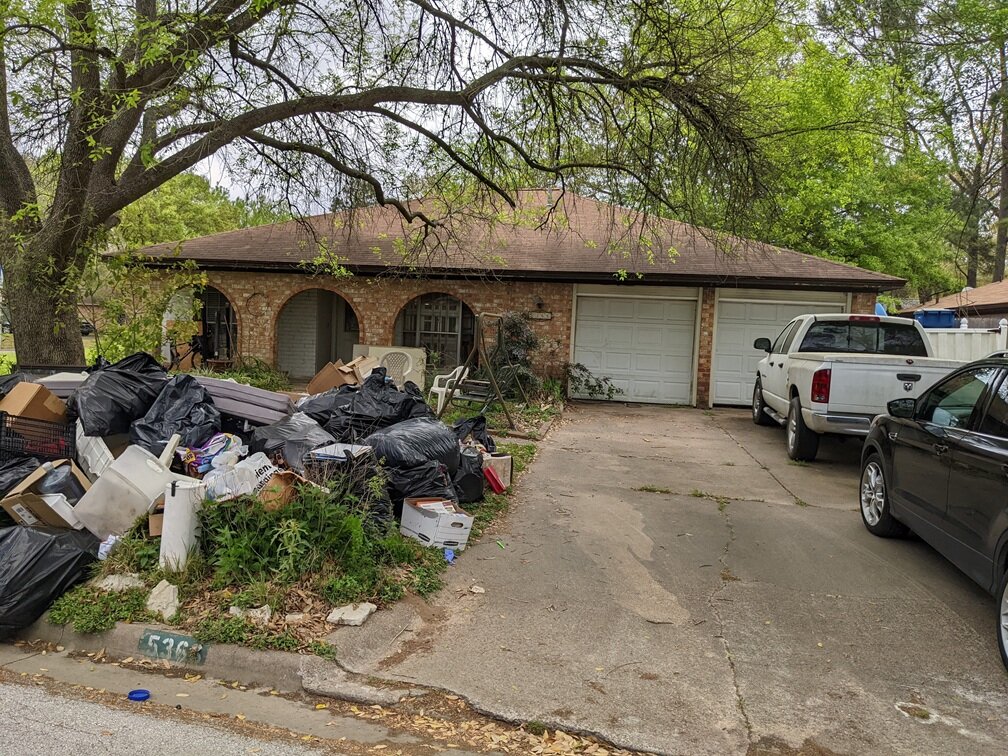
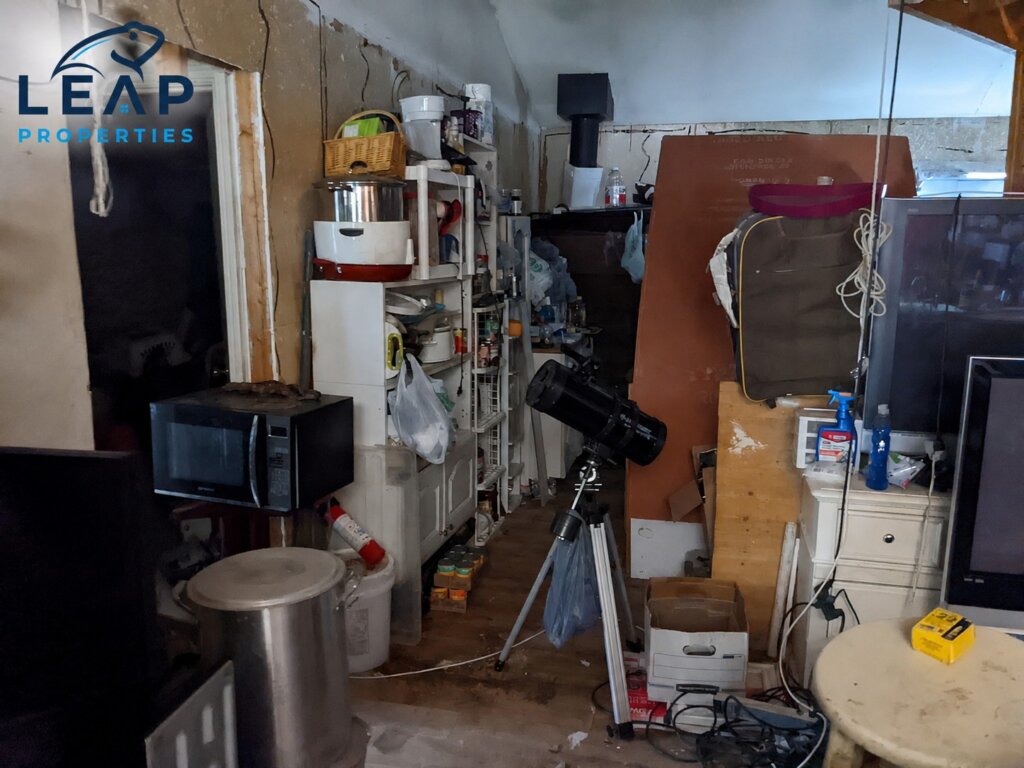
Below is a case study of a hoarder house we bought a few years ago. I like this one as a case study to show because the seller went through the process of trying to decide what to do with it. After getting quotes and seeing that it would cost 10’s of thousands of dollars to clean out, they decided that they would do some of the clean-out themselves. They spent the entire weekend at the house, and sacked up almost 60 contractor trash bags, then placed it by the side of the road. After realizing that after all that work, they had barely made a dent in it, and also seeing that there was human waste, mold, rats and roaches everywhere, they decided it was too much.
They reached out to us to see about getting a quote. Our offer was $55,000 for the house. They knew that houses in the neighborhood would sell for $275,000, but they also had the quotes for trash-out and biohazard decontamination certificate which were around $30,000. They also had the quotes from the general contractors which were $175-$200,000 and would take months to basically build a new house. If they hadn’t known the actual cost, $55,000 would have probably seemed like a lowball offer, but since they

Property Overview
- Severe Level 5 hoarding situation
- Approximately 1,500 square feet
- Required eight 40-yard dumpsters for cleanup
- Katy, Texas
Scenario 1: Fully Renovate and Sell
- After-Repair Value (ARV): approximately $275,000
- Estimated cleanup and renovation costs: approximately $185,000
- Timeline 4-6 months
- Estimated profit after selling costs: approximately $68,000
Takeaway
This option produced the highest potential return, but also required the most money, time, and risk.
Scenario 2: Sell As-Is After Cleanup
- Estimated sale price: approximately $100,000
- Cleanup costs: approximately $30,000
- Timeline 1-3 months
- Estimated profit after selling costs: approximately $62,000
Takeaway
The seller achieved nearly the same financial result as a full renovation while avoiding months of construction and major project management.
Scenario 3: Sell Directly to a Cash Buyer
- Cleanup costs: $0
- Repair costs: $0
- Timeline 7-14 days
- See completely as-is for $55,000
Takeaway
After the seller did their due diligence and ran the numbers, they decided to sell to us. They received less overall money but avoided all stress, cleanup, repairs, and holding costs while closing quickly.
Part 5: Resources for Texas Families
You do not have to do this alone. These resources help.
Mental health and family support
- International OCD Foundation: hoarding.iocdf.org — therapist directory and support groups
- Institute for Challenging Disorganization: challengingdisorganization.org — directory of professional organizers trained in hoarding
- Buried in Treasures workshops: peer-led groups based on the book by Tolin, Frost, and Steketee
- SAMHSA National Helpline: 1-800-662-4357 (free, confidential, 24/7)
- Mental Health America Texas: mhatexas.org
Texas-specific
- Texas Adult Protective Services: 1-800-252-5400 — for vulnerable adults at risk
- Houston Hoarding Task Force (multi-agency: HFD, HPD, public health, code enforcement)
Cleanout and biohazard companies operating statewide in Texas
- Bio-One (multiple Texas locations)
- Steri-Clean Texas
- Spaulding Decon
- Aftermath Services
- Address Our Mess
Part 6: Frequently Asked Questions
How fast can a hoarder house actually close in Texas? In our experience, the fastest closing is about seven calendar days, assuming clear title. Most close in 14 to 21 days. Probate cases take longer, depending on the court calendar, usually 30 to 60 days.
Do I need to clean the house before selling to a cash buyer? No. A real cash buyer takes the property exactly as it sits. Take what you want — photo albums, important documents, family heirlooms — and leave the rest. We handle every bag, every piece of furniture, every appliance. If a buyer asks you to clean first, they are probably not actually a cash buyer.
Will my offer be lower because the house is in bad shape? Yes, but probably not for the reason you think. The offer is lower because the buyer is taking on the cleanup cost, the repair cost, the holding cost, and the risk that something even worse turns up. A reasonable Texas cash offer on a Level 3 to Level 5 hoarder home runs 65 to 75 percent of after-repair value. If anyone offers you 80 percent or more, ask them to put it in writing and verify their proof of funds.
What happens to the stuff inside the house? After closing, anything left in the house belongs to the buyer. We dispose of it responsibly: usable items go to local nonprofits (Goodwill, Salvation Army, family resource centers), and the rest is hauled to licensed disposal. Before closing, take what matters to you. We can also coordinate an estate sale or a personal-property auction if there are valuables you want to liquidate.
Can I sell if the house has been condemned? Yes. A condemned home in Texas is still real estate, and the land value alone usually makes the property worth selling. Cash buyers regularly purchase condemned properties to demolish and rebuild. The city’s condemnation order does not block the sale itself.
A Final Word
If you got this far, you are doing the work most families do not. You are reading. You are planning. You are looking for a path that respects your loved one and protects your family. That is exactly the right place to start.
A hoarder house is not a moral verdict on anyone. It is a problem to solve. Texas gives you good tools to solve it: efficient probate, professional cleanout companies, real cash buyers, strong title work. Whichever path you choose, there is a version of this story that ends with the house sold, the family at peace, and your parent’s memory honored. We see it every month.
If LEAP can help, either with a cash offer, with a referral, or with a free conversation about your options, we are here. No pressure. No pitch. Just real help from people who do this every day in Texas.
Get A Cash Offer For Your House Today!
Fill Out The Form To Get Started!