

Understanding Texas Probate and Selling A House
What Constitutes the Texas Probate Process?
Probate is the legal process through which a court recognizes a person’s death and oversees the payment of debts and distribution of assets. In Texas, this process is governed by the Texas Estates Code. For anyone selling a house owned by a deceased individual, understanding the specific type of probate required is the first step toward a valid sale.
When Is Probate Necessary in Texas?
Probate is necessary when a person dies leaving assets titled in their name that do not have a designated beneficiary or right of survivorship.
- Sole Ownership: If a parent dies owning a home solely in their name, that home is “stuck” in the estate. No deed can be signed to transfer it until a judge grants authority to an executor or administrator.
- Tenancy in Common: If the deceased owned a share of a property as a tenant in common, their share does not automatically go to the other owners; it passes to their heirs, requiring probate to verify who those heirs are.
Assets that generally avoid probate include:
- Living Trusts: Property titled in the name of a Revocable Living Trust.
- Transfer on Death Deeds (TODD): If filed prior to death, ownership transfers automatically.
- Survivorship Agreements: Property held as “Joint Tenancy with Right of Survivorship”.
What Is the “Four-Year Rule” for Texas Wills?
Texas law imposes a strict statute of limitations on wills. A will must be submitted for probate within four years of the testator’s death.
- Consequences of Missing the Deadline: If the will is not probated within four years, it generally cannot be used to appoint an executor or administer the estate. The will may potentially be admitted only as a “Muniment of Title” (proof of ownership) but cannot govern the administration.
- Intestacy Default: Often, if the deadline is missed, the court treats the estate as intestate (no will). Texas laws of descent and distribution then dictate that assets pass to legal heirs (spouse, children, parents) regardless of what the expired will stated. This often leads to “heirship” complications where dozens of distant relatives acquire fractional ownership of a single house.
How Do Costs and Timelines Vary by Probate Type?
The cost and duration of probate depend heavily on the procedure selected.
| Probate Type | Average Timeline | Estimated Attorney Fees | Key Characteristic |
| Independent Administration | 6 – 12 Months | $1,500 – $3,000 | Minimal court supervision; standard for valid wills. |
| Dependent Administration | 1 – 2+ Years | $5,000 – $10,000+ | High court supervision; required for disputes/debts. |
| Muniment of Title | 30 – 60 Days | $1,000 – $2,000 | No executor appointed; transfers title only. |
| Small Estate Affidavit | 30 – 60 Days | $500 – $1,500 | Estates <$75,000 (excluding homestead). |
How Does Independent Administration Work?
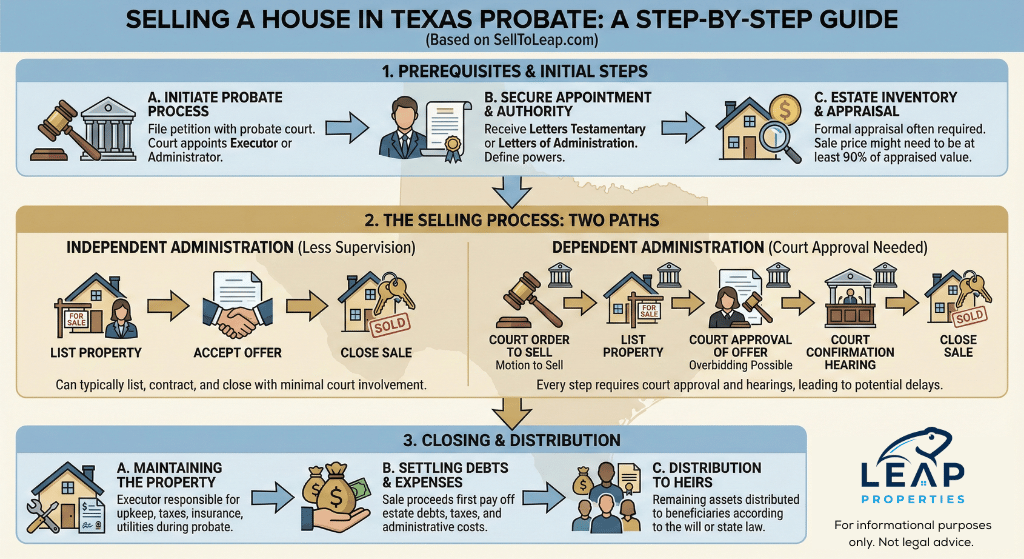
Independent Administration is the “gold standard” of Texas probate, designed to be efficient and cost-effective. It allows the executor to manage the estate largely free of judicial micromanagement.
How Is an Independent Executor Appointed?
An executor can serve independently if:
- The Will Provides for It: The will explicitly states that the executor shall act “independent of the probate court”.
- Consent of Beneficiaries: If the will is silent (or there is no will), all beneficiaries can agree in writing to an independent administration, subject to court approval.
Once appointed, the executor receives “Letters Testamentary.” These documents are the “keys to the castle,” proving to banks, title companies, and buyers that the executor has the legal authority to act.
Does an Independent Executor Need Court Permission to Sell?
Generally, no—provided they have the “Power of Sale.”
- Explicit Power: Most well-drafted wills include a clause granting the executor the power to sell real estate. In this case, the executor signs the deed and closes the sale without ever talking to the judge.
- Consent to Power: If the will does not list the power of sale, or if there is no will, the Texas Estates Code (Section 145A/145C) allows beneficiaries to consent to give the administrator this power. Without this specific authority, title companies may refuse to insure the sale unless all heirs sign the deed or a court order is obtained.
How Does Dependent Administration Differ?
Dependent Administration is the default when complications arise—such as fighting heirs, high debts, or the absence of a will where heirs cannot agree. It is characterized by strict court oversight.
Why Is Dependent Administration More Expensive?
In a dependent administration, the administrator acts as an agent of the court. They essentially cannot spend a dollar or sell an asset without a judge’s signature.
- The Bond: The administrator must post a corporate surety bond (insurance) to protect the estate assets from mismanagement or theft. This costs money and requires the administrator to be creditworthy.
- Legal Fees: Because every action requires a motion, a hearing, and an order, the attorney must bill for significantly more hours than in an independent administration.
What Is the 4-Step Process for Selling a House in Dependent Administration?
Selling real estate in a dependent administration is a rigid statutory process. Failing to follow these steps renders the sale void.
- Application for Sale (Estates Code § 356.251): The administrator files an application asking permission to hire a realtor or sell the property. They must prove the sale is necessary to pay debts or is in the best interest of the estate.
- Report of Sale (Estates Code § 356.551): Once a buyer is found and a contract is signed, the administrator files a “Report of Sale” with the court within 30 days. This report must detail the price, the buyer’s name, and the terms.
- The 5-Day Waiting Period: The Report of Sale must sit on the court’s docket for at least five days to allow any interested parties (creditors or heirs) to object.
- Decree of Sale (Estates Code § 356.556): The judge holds a hearing. If the judge is satisfied that the property was sold for a “fair price” and in conformity with the law, they issue a Decree of Sale (or Order of Confirmation). Only after this decree is signed can the administrator sign the deed and transfer the property.
Implication for Sellers: This process adds 30 to 60 days to the closing timeline. Sellers must ensure their buyer (whether an individual or a company like Leap Properties) is willing to wait for this court approval. Standard residential contracts often need a specific addendum to address this “Subject to Court Approval” contingency.
Want To Skip The Probate Hassle?
Get A Cash Offer For Your House Today!
Fill Out The Form To Get Started!
What Are Muniments of Title and When Are They Used?
A “Muniment of Title” is a simplified probate procedure unique to Texas that treats the will as a link in the chain of title rather than appointing an executor to manage assets.
How Does the Process Function?
The applicant files the will and asks the court to admit it as a “Muniment of Title.”
- The Hearing: The court reviews the will to ensure it is valid.
- The Order: If approved, the judge issues an order admitting the will to probate.
- The Transfer: A certified copy of the will and the court order are recorded in the county property records. These documents function effectively as a deed, transferring ownership to the beneficiaries named in the will.
What Are the Restrictions?
Muniment of Title is only permitted if:
- The estate has no unpaid debts, except for debts secured by liens on real estate (like a mortgage).
- There is no need for administration (e.g., no need to pursue lawsuits or complex asset division).
Risk Factor: Out-of-state financial institutions often do not understand Muniment of Title. If the deceased had a stock account in New York, that bank might refuse to release funds without “Letters Testamentary,” which Muniment of Title does not provide. However, for an estate consisting solely of a Texas house, it is an efficient and cheaper solution.
How Do Affidavits of Heirship Work?
When a person dies intestate (without a will), an “Affidavit of Heirship” is often the most cost-effective way to clear title to a home, provided the family situation is straightforward.
What Does the Document Do?
An Affidavit of Heirship is a sworn statement recorded in the real property records. It lists the family history, marriages, and children of the deceased to establish who inherited the property under Texas law.26 It does not transfer title technically; it creates a presumption of ownership that title companies can accept.
What Are the Requirements for Validity?
To be accepted by title companies and courts, the affidavit typically requires:
- Signature of Heirs: All potential heirs should sign.
- Two Disinterested Witnesses: Two people who knew the decedent for a significant period (often 10+ years) and who have no financial interest in the estate must sign and swear to the facts.
- Notarization: All signatures must be notarized.
Why Do Title Companies Hesitate?
Texas Estates Code § 203.001 states that an affidavit on file for five years is prima facie evidence of the facts stated. However, for affidavits filed recently (less than 5 years), title companies assume a risk. If a “hidden heir” (e.g., a child from an undisclosed affair) appears later, they could claim ownership.
Consequently, title companies often require strict adherence to the witness rules and may deny the affidavit if the estate is large or the family history is messy.30 In such cases, a judicial “Determination of Heirship” (a formal court proceeding) becomes necessary, which costs significantly more.
What Documents Are Essential for the Sale?
A successful sale requires a precise compilation of legal and title documents.
| Document Category | Specific Documents Required | Purpose |
| Proof of Authority | Letters Testamentary, Letters of Administration, or Order Admitting Will as Muniment of Title. | Proves the signer has the legal right to sell. |
| Proof of Identity | Death Certificate (Certified Copy). | Establishes death and triggers tax/title changes. |
| Title Clearance | Release of Liens, Payoff Statements for Mortgages. | Ensures the buyer gets “clear title.” |
| Transfer Instruments | Executor’s Deed, Administrator’s Deed, or General Warranty Deed (signed by all heirs). | Technically transfers ownership. |
| Disclosure | Seller’s Disclosure Notice (often exempt for Executors). | Informs buyer of condition (Executors/Administrators/Heirs who haven’t lived in the property are often exempt from full disclosure under Texas Property Code).32 |
Who Signs the Deed?
- Independent Executor: Signs alone (if power of sale exists).
- Dependent Administrator: Signs alone, but ONLY after the Court Decree is signed.
- Heirs (Intestate/Muniment): All heirs listed in the Affidavit or Will must sign. If there are 15 heirs, all 15 signatures (and often their spouses’) are required.
What Are the Financial Implications of Selling Inherited Property?
The financial landscape of an inherited home involves taxes, holding costs, and potential repair investments.
How Does the “Stepped-Up Basis” Affect Capital Gains?
The “stepped-up basis” is a primary tax benefit for heirs. When a property is inherited, its cost basis for tax purposes is reset to its fair market value on the date of death.
- Scenario: A house purchased in 1980 for $40,000 is worth $340,000 at the time of death in 2026.
- Result: If the heir sells the house for $340,000, the capital gain is $0 ($340k Sale Price – $340k Basis).
- Contrast: If the parents had “gifted” the house to the child before dying, the child would retain the $40,000 basis, resulting in a taxable gain of $300,000 upon sale.
How Are Property Taxes Handled?
Texas property taxes are among the highest in the nation. A critical pitfall for heirs is the expiration of exemptions.
- Over-65 Exemption: If the deceased parent had an Over-65 or Disability exemption, their tax bill was likely frozen or significantly reduced.
- Reset upon Death: These exemptions expire when the owner dies (unless a surviving spouse qualifies). The estate or heirs will be responsible for taxes at the full, unexempted value. This can cause the annual tax bill to jump from $1,000 to $6,000 or more overnight. Heirs must budget for this prorated liability at closing.
What Are the “Holding Costs” of Probate?
Probate is not instant. During the 6 to 12 months (or longer) that a house sits in probate, the estate bleeds cash.
- Utilities: Electricity must be kept on to prevent humidity damage/mold ($150/mo).
- Insurance: Vacant home policies are expensive ($200+/mo).
- Maintenance: Lawn care, HOA fees ($100+/mo).
- Taxes: Accruing monthly ($500+/mo).Total Cost: An estate can easily spend $1,000 to $1,500 per month just to keep an empty house. For a house that sits on the market for 96 days (current average) plus a 45-day closing, holding costs can erode $5,000 to $10,000 of equity.
What Are Common “Horror Stories” and How Can They Be Avoided?
Probate complications can turn a simple inheritance into a legal quagmire.
The “Lost Will” Nightmare
If a family knows a will existed but cannot find the original, Texas law presumes the testator destroyed it with the intent to revoke it.
- Result: The estate goes intestate. Property might pass to a different set of heirs than the deceased intended (e.g., sharing the house with children from a previous marriage rather than the current spouse).
- Solution: Check safe deposit boxes immediately. If only a copy exists, a lawyer must rebut the presumption of revocation in court, which is difficult and expensive.
The “Medicaid Clawback” (MERP)
If the deceased received Medicaid benefits for nursing home care after age 55, the State of Texas (via MERP) has a priority claim against the estate assets.
- Result: When the house is sold, the state demands repayment from the proceeds. In some cases, the claim consumes the entire equity of the home, leaving heirs with nothing.
- Solution: There are exceptions (e.g., if a disabled child or surviving spouse lives in the home). An elder law attorney should review the MERP claim status before listing the property.
The “Holdout Heir”
In an intestate inheritance where four siblings inherit a house equally, all four must agree to sell.
- Result: If one sibling refuses to sign the deed (perhaps they are living in the house rent-free), the sale halts.
- Solution: The other heirs must file a “Partition Suit,” asking the court to force the sale of the property. This is an expensive lawsuit that depletes the estate’s value. Mediation is often a cheaper first step.
What Is the Step-by-Step Strategy for Sellers?
To navigate the 2026 Texas market successfully, sellers should follow a disciplined roadmap.
- Secure the Premises: Change locks, maintain insurance, and keep utilities on.
- Determine Legal Status: Consult a probate attorney to decide between Independent Administration, Muniment of Title, or Affidavit of Heirship.
- Order a Title Search: Do not wait for a buyer. Order a preliminary title report to see if there are liens, judgments, or tax suits against the property.
- Calculate Net Equity: Estimate fair market value, then subtract:
- Mortgage payoff.
- Estimated repairs (for retail sale).
- Realtor commissions (6%).
- Holding costs (6 months).
- Closing costs (2%).
- Solicit Offers:
- Get a retail valuation from a realtor.
- Get a cash offer from Leap Properties.
- Compare Net vs. Net: Compare the guaranteed cash offer against the potential retail sale (minus commissions, repairs, and holding costs). Often, the gap is narrower than expected, making the cash option rational for risk-averse heirs.
- Close: Ensure all heirs sign. Funds are typically wired to the “Estate of [Name]” bank account, not personal accounts (unless utilizing Affidavits of Heirship).
Conclusion
The Texas legal framework provides multiple tools—from Independent Administration to Affidavits of Heirship—that, when correctly applied, can unlock the value of these assets.
If you don’t want to deal with all the legal headaches, timeless research and lots of stress, we can help! We buy probate houses and inherited houses.
Get A Cash Offer For Your House Today!
Fill Out The Form To Get Started!