

Evicting a tenant in Texas is faster than in most states, and the process became even faster in 2026. But landlords must follow every step correctly. The most common reason a landlord loses an eviction case is not because the court feels sorry for the tenant. It is because the landlord gave the eviction notice the wrong way.
This guide explains each step of the Texas eviction process after the January 2026 changes. It covers the reason for eviction, the notice, filing the case, the court hearing, appeals, and the constable. It also explains the real cost and how long the process usually takes in the Houston area.
We have bought many homes in the Houston area, including homes with tenants still living in them. Because of this, we know the eviction process and the problems that can come after it. Some steps are simple enough to handle on your own. For other steps, it may be worth paying a professional. We will explain which is which.
| The short version First, give the tenant a written notice to move out. In most cases, the notice gives the tenant three days. Next, file an eviction case in the justice of the peace court for the area where the property is located. The court hearing will usually be held 10 to 21 days after you file. If you win, the tenant has five days to appeal. After that, you can ask the court for a writ of possession. The court cannot issue it until at least six days after the judgment. The constable will then post a 24-hour warning before removing the tenant. An eviction with no appeal usually takes about three to five weeks. Court and constable fees are often about $300 to $340. Never try to force the tenant out by changing the locks or shutting off utilities. You could be ordered to pay one month’s rent, another $1,000, damages, and the tenant’s attorney fees. |
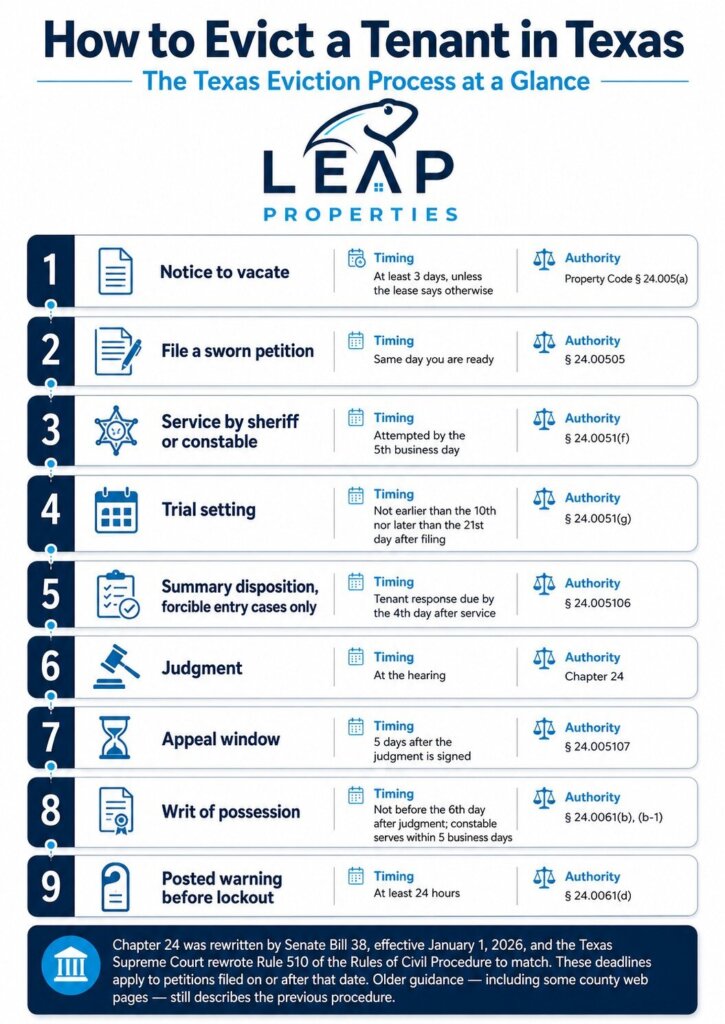
The Texas Eviction Process at a Glance
| Step | Timing | Authority |
|---|---|---|
| Notice to vacate | At least 3 days, unless the lease says otherwise | Property Code § 24.005(a) |
| File a sworn petition | Same day you are ready | § 24.00505 |
| Service by sheriff or constable | Attempted by the 5th business day | § 24.0051(f) |
| Trial setting | Not earlier than the 10th nor later than the 21st day after filing | § 24.0051(g) |
| Summary disposition, forcible entry cases only | Tenant response due by the 4th day after service | § 24.005106 |
| Judgment | At the hearing | Chapter 24 |
| Appeal window | 5 days after the judgment is signed | § 24.005107 |
| Writ of possession | Not before the 6th day after judgment | § 24.0061(b), (b-1) |
| Posted warning before lockout | At least 24 hours | § 24.0061(d) |
Chapter 24 was rewritten by Senate Bill 38, effective January 1, 2026, and the Texas Supreme Court rewrote Rule 510 of the Rules of Civil Procedure to match. These deadlines apply to petitions filed on or after that date. Older guidance — including some county web pages — still describes the previous procedure.
Step 1: Establish Legal Grounds
You need a reason, and the reason determines your notice and your proof.
Non-Payment of Rent
The most common reason for eviction is that the tenant owes rent and has not paid it.
Check your lease before counting the days. It may include a grace period or rules about late fees. There is also a special rule for some unpaid rent cases. When the tenant is late for the first time and nonpayment is the only reason for the eviction, the notice must give the tenant a choice: pay the rent or move out. It cannot only tell the tenant to leave.
Keep a clean payment ledger. Judges want to see what was owed, what was paid, and when, and doesn’t want to hear a story.
Lease Violation
Lease violations may include people or pets who are not allowed, property damage, illegal activity, or other actions banned by the lease.
These cases can be harder than evictions for unpaid rent. First, you must prove the violation happened. Photos, written complaints, and clear dates can help. Second, the lease must clearly say the action is not allowed. A judge will look at the lease, so it is not enough to say, “Everyone knows you cannot do that.”
Holdover After Lease End
The lease has ended, but the tenant is still living in the property. This is usually a simple eviction if the lease truly expired and you did not accept rent after it ended. Accepting rent may create a new month-to-month lease and make the eviction harder.
For a month-to-month lease, you must first give notice that the lease is ending. Under Section 91.001, the lease ends on the date listed in the notice or one month after the notice is given, whichever is later.
After the lease has ended, you can give the tenant a notice to vacate and file the eviction case. Skipping the first notice is a common mistake that can cause you to lose the case.
This rule may not apply if the lease has a different notice period or says that no notice is required.
Step 2: The Notice to Vacate
The notice to vacate is where most cases are won or lost. Get it wrong and the judge dismisses, and you start over having lost three weeks.
The 3-Day Default (and When the Lease Changes It)
Section 24.005 requires at least three days’ written notice to vacate for a tenant under a written or oral agreement, and for a tenant at will or by sufferance — unless the lease provides for a shorter or longer period, in which case the lease controls.
Read your own lease before counting. Plenty of Texas leases specify one day, and plenty specify more than three. The lease wins.
The exceptions to the three-day default:
- Your lease says otherwise — by far the most common variation.
- Post-foreclosure. A purchaser at a tax or trustee’s foreclosure sale under a lien superior to the lease must give a residential tenant who is paying on time and not otherwise in default at least 30 days. And where the federal Protecting Tenants at Foreclosure Act applies, a bona fide tenant may be entitled to 90 days — federal law is a floor, so the longer period controls.
- Forcible entry. Where the occupant got in without your consent, Section 24.005(d) allows notice to be oral or written, and it may demand they vacate immediately. You do not owe a stranger three days.
The notice should identify the property, state that the tenancy is terminated and they must vacate, give the deadline, and be dated and signed. Keep a copy and a record of how and when you delivered it.
How to Deliver It Properly
The delivery rules changed on January 1, 2026, and the old method most landlords learned is no longer in the statute.
Section 24.005(f-3) now permits:
- Mail — first class, registered, certified, or by a delivery service.
- Delivery inside the premises, in a conspicuous place.
- Hand delivery to any tenant 16 or older.
- Electronic communication, including email — but only if the parties agreed to that in writing.
What was repealed: the old rules about affixing the notice to the OUTSIDE of the main entry door in a specially marked envelope. That method is gone from the statute. If your process still involves taping an envelope to the outside of the front door, update it.
There is a saving provision — the delivery rules do not apply where the tenant actually received the notice. But do not rely on it. Use a permitted method and document it.
Step 3: File the Eviction Suit
Texas calls it forcible entry and detainer. It is heard in the justice of the peace court for the precinct where the property is located — not where you live, and not in district court.
Since January 2026 the petition must be sworn, under Section 24.00505. An unsworn petition can get you dismissed.
Finding the Right JP Precinct
Harris County has sixteen justice of the peace courts across eight precincts. Montgomery and Fort Bend each have their own precinct courts. Filing in the wrong precinct wastes the filing fee and the weeks.
Look up the precinct by the property address on the county’s JP court website before you file. If you are unsure, call the clerk — they will tell you.
Filing Fees by County
| Harris County | Montgomery County (Pct. 4) | |
|---|---|---|
| Court costs | $54 | $54 |
| Service per defendant | $85 | $125 |
| Total, one defendant | $139 | $179 |
| Total, two defendants | About $224 | $304 |
| Writ of possession | $5 issuance + $155 execution = $160 | $5 + $150 = $155 |
| Jury fee, if requested | $22 | $22 |
Harris County figures from the Justice Courts civil fee schedule published January 2025; Montgomery from the Precinct 4 schedule updated January 2026. Court costs are set by statute and uniform, but constable service fees are set by each county’s commissioners court and vary by precinct. Confirm with your precinct.
Service of Citation
The initial citation must be served by a sheriff or constable, and not by the landlord or an ordinary private process server.
If it has not been served within five business days after filing, the landlord may request an alias citation for service by another law-enforcement officer
If your case is a forcible entry and detainer — meaning the occupant came in without your consent — you may also file a sworn motion for summary disposition alongside the petition. If the motion shows no genuinely disputed facts, the court can enter judgment without a trial at all.
Read this limit carefully, because it is the most misunderstood part of the 2026 changes. Summary disposition is available only in forcible entry cases. It cannot be used against a tenant, a subtenant, an immediate family member, anyone with an ownership claim, or anyone who began living at the property legally. If your problem is a tenant who stopped paying, this door is closed and you are on the standard track.
Step 4: The Hearing
Trial is set not earlier than the 10th and not later than the 21st day after the petition is filed, and no trial can happen until four days have passed after service.
These hearings are short. Fifteen minutes is normal when the landlord came prepared.
What to Bring
- The lease, signed, with any amendments.
- A payment ledger showing what was owed and what was received, by date.
- Your notice to vacate and proof of how and when you delivered it. This is the document judges check first.
- Photographs, if condition or a lease violation is the issue.
- Written communications with the tenant.
- Proof you own the property — a deed or tax statement.
Bring copies for the judge and the tenant. Organize them in the order you will use them.
Common Tenant Defenses
- Defective notice. Wrong number of days, wrong delivery method, or no notice. The most successful defense by a wide margin.
- Rent was paid, or partially paid and accepted. Accepting a partial payment can undercut a non-payment case.
- Retaliation. A tenant who recently requested repairs or complained to a code authority may argue the eviction is retaliatory.
- Failure to repair, raised where the landlord did not address a condition affecting health or safety.
- Wrong party or wrong precinct.
- No landlord-tenant relationship — raised where the occupant claims to be an owner or an heir.
Note that under the 2026 changes the tenant cannot bring counterclaims or join third parties in an eviction case. The only question is possession.
Step 5: The Judgment and the 5-Day Appeal Window
If you win, you get a judgment for possession, and often for unpaid rent and costs as well.
The tenant then has five days from the date the judgment is signed to appeal, by filing a bond, a cash deposit, or a statement of inability to afford court costs. That deadline is now statutory, in Section 24.005107.
An appeal moves the case to county court for a completely new trial. That adds roughly four to eight weeks.
Appeal Bonds and Pauper’s Affidavits
A tenant who cannot afford a bond can file a statement of inability to afford payment of court costs. That is a real route and it is used often.
One 2026 change worth knowing: a tenant appealing must now affirm under penalty of perjury that they believe in good faith they have a meritorious defense and that the appeal is not being taken for delay. That is aimed squarely at appeals filed purely to buy time.
If the tenant appeals and stays in the property, the county court can require them to pay rent into the court registry during the appeal. Ask about it — it is the main protection you have during that period.
Step 6: Writ of Possession and Constable Lockout
A judgment does not remove anyone. You need a writ of possession, and there are built-in waiting periods.
A writ may not be issued before the sixth day after the judgment is signed, unless a possession bond was filed and approved. Since January 2026, issuing the writ is a ministerial act not subject to review or delay, and the sheriff or constable must serve it no later than the fifth business day after it is issued. That removed a real source of delay.
Before executing, the officer posts a written warning at least 8.5 by 11 inches on the outside of the front door, stating the writ will be executed on or after a specific date and time — not sooner than 24 hours after the warning goes up.
On execution the constable delivers possession to you, instructs the occupants to leave, physically removes them if they refuse, and moves their personal property outside to a nearby spot. The statute says it cannot block a sidewalk, passageway, or street, and cannot be set out while it is raining, sleeting, or snowing. There is a warehouseman option if you would rather have the belongings stored.
Scheduling matters: the writ must be issued within 60 days of judgment, extendable to 90 for good cause, and cannot be executed after the 90th day. Do not win your case and then let it sit.
Be there for the lockout, or have someone there, with a locksmith. The constable will not wait.
Realistic Timelines by County
| Scenario | Realistic time from notice to lockout |
|---|---|
| Uncontested, tenant does not appear | 3 to 5 weeks |
| Contested at the JP hearing, no appeal | 4 to 6 weeks |
| Appealed to county court | 8 to 14 weeks |
| Forcible entry case using summary disposition | Potentially under 4 weeks, sometimes 2 to 3 where notice was immediate |
| Unauthorized occupant removed under Chapter 24B | Potentially days, but only where the statute applies |
County differences are mostly about docket volume rather than law. Harris County’s precincts run high volume and settings can be tighter or looser depending on the precinct. Montgomery and Fort Bend generally move a little faster simply because there are fewer cases.
Be skeptical of anyone promising ten days. The notice period plus the trial setting plus the writ waiting period make that arithmetically impossible outside a possession-bond scenario.
What Eviction Actually Costs
| Item | Cost |
|---|---|
| Filing and service, one defendant | $139 in Harris, $179 in Montgomery Pct. 4 |
| Each additional defendant | $85 to $125 |
| Writ of possession | $155 to $160 |
| Jury fee, if requested | $22 |
| Attorney, if you use one | Commonly $500 to $1,500 for an uncontested eviction |
| Locksmith at the lockout | $75 to $200 |
| Court and constable fees, clean uncontested case | About $300 to $340 |
What that table leaves out is the real cost. Lost rent during the process, unpaid rent you will probably never collect, turnover and repairs after, and the vacancy while you re-let. On a house renting for $1,800 a month, a five-week eviction plus a month of turnover costs far more than the filing fees.
That is the honest case for considering cash for keys, covered below.
Collecting Back Rent and Damages
You can ask for unpaid rent in the eviction suit, up to the justice court’s jurisdictional limit, and most landlords do.
Getting a judgment and collecting on it are different things. A tenant who could not pay rent generally cannot pay a judgment either. Your options afterward — wage garnishment is not available for ordinary debts in Texas, so you are looking at bank account garnishment or abstracting the judgment as a lien, both of which take more work and more money.
On the security deposit: you must refund it, or provide a written itemization of deductions, within 30 days after the tenant surrenders possession and gives a forwarding address. A landlord who retains a deposit in bad faith is liable for $100 plus three times the wrongfully withheld amount plus attorney’s fees — and bad faith is presumed if you do nothing by day 30.
So do the itemization even when the tenant owes you far more than the deposit. It costs an hour and it removes a counterclaim.
Practical view: most landlords apply the deposit, write off the rest, and move on. Chasing a judgment against someone with no assets is usually money after money.
What You Can’t Do: Illegal Self-Help Eviction
This section exists because every year Houston-area landlords turn a winnable case into a check they have to write.
| What you cannot do | Statute | What it costs you |
|---|---|---|
| Change the locks or otherwise prevent entry except by judicial process | § 92.0081 | Tenant may recover possession or terminate the lease, plus one month’s rent plus $1,000, actual damages, court costs and attorney’s fees |
| Remove a door, window, attic hatchway cover, lock, latch, hinge, hinge pin or doorknob | § 92.0081 | Same |
| Remove landlord-furnished furniture, fixtures or appliances | § 92.0081 | Same |
| Shut off water, wastewater, gas or electricity | § 92.008 | Possession or lease termination, plus actual damages, one month’s rent plus $1,000, attorney’s fees and court costs |
| Set the tenant’s belongings on the curb yourself | Only the constable does this, under a writ | Same exposure as a lockout, plus a claim for whatever goes missing |
There is a narrow lock-change exception for non-payment of rent, but it comes with detailed conditions — written notice, a key available at all hours, and more. Most landlords who try it fail one of the conditions.
The tenant also has a fast remedy: a writ of re-entry or a writ to restore utility service, costing roughly $205 to $210 in Harris and Montgomery counties. They can be back in the house with a court order within days, and now you are the one who broke the law.
A lease clause purporting to waive the utility protections is void.
Cash for Keys as a Faster Alternative
Offering a tenant money to leave voluntarily is often cheaper and faster than eviction.
The math is simple. An eviction costs $300 to $340 in fees, takes three to five weeks of lost rent, and frequently ends with a damaged unit because a tenant being forced out has no incentive to leave it clean. A few hundred to a couple of thousand dollars, paid on the day they hand over the keys with the place broom-clean, often beats that.
The rules that make it work: get it in writing, specify the move-out date and the condition, include a mutual release, and pay only on surrender of the keys. Never pay in advance.
It stings to pay someone to leave a property you own. It stings less than eight weeks and a contested appeal.
Selling Instead of Evicting
Worth putting on the table honestly, because for some landlords the eviction is not the problem, being a landlord is.
You can sell a house with a tenant in it. The lease generally survives the sale and the buyer steps into your shoes, which rules out most owner-occupant buyers but not investors. You can also sell to a buyer who will handle the removal themselves.
When selling makes more sense than evicting:
- This is not the first problem tenant, and the property has been a drain for a while.
- The unit needs significant work that you would have to fund before re-letting.
- You live out of state and cannot manage the court dates or the turnover.
When it does not: the property is otherwise performing, this is a one-off bad tenant, and you have the time. Evict, turn it over, re-let.
Our page on how to sell the property with the tenant still in it covers the mechanics — leases, deposits, and what a buyer will want to see.
2025-2026 Texas Eviction Law Changes
Two separate laws changed this area, and they do different things. Conflating them is the most common error in current writing on the topic.
| Senate Bill 38 | Senate Bill 1333 | |
|---|---|---|
| Effective | January 1, 2026, for petitions filed on or after that date | September 1, 2025 |
| What it created | A rewritten Chapter 24 court process | New Property Code Chapter 24B |
| Who it applies to | Anyone who is or claims to be a tenant | Unauthorized occupants who are NOT current or former tenants and NOT immediate family |
| The mechanism | Summary disposition, tighter deadlines, ministerial writs | A sworn complaint to the sheriff or constable, who verifies record ownership and serves notice to vacate immediately |
| Speed | Faster court process | Pre-litigation — potentially days |
What SB 38 changed inside Chapter 24: sworn petitions are now required; summary disposition is available in forcible entry cases with the tenant’s response due by the fourth day after service; trial is set between the 10th and 21st day; the appeal deadline is now statutory at five days; issuing a writ of possession is ministerial and must be served within five business days; notice delivery was modernized and the outside-door posting rules were repealed; and individual courts are limited in what local rules they can add.
Chapter 24B is the genuinely new tool for true squatters, and it comes with a serious guardrail. Under Section 24B.005, a person wrongfully removed can recover possession, actual damages, and exemplary damages equal to three times the fair market rent, plus costs and attorney’s fees. Use it only where you are confident the occupant is not and never was a tenant.
SB 1333 also created two new criminal offenses: presenting a fake lease or deed is a Class A misdemeanor, and fraudulently listing, renting, or selling property you have no title to is a first-degree felony.
One correction worth making because it circulates widely: House Bill 32 from the 2025 session died and never became law. Sources citing it as the Texas squatter statute are wrong — the real one is SB 1333. And SB 38’s caption mentions unauthorized occupants, but the bill did not add them to Chapter 24; squatter coverage there comes from the pre-existing tenant-at-sufferance provision. For the full picture see squatters rights in Texas.
Also worth knowing, because Harris County’s own eviction pages have not fully caught up: verify procedure against the statute or with the clerk, not against a county web page.
Frequently Asked Questions
How long does it take to evict a tenant in Texas?
Three to five weeks from notice to lockout for an uncontested case — a three-day notice, a trial set between the 10th and 21st day after filing, then a writ that cannot issue before the sixth day after judgment plus a 24-hour posted warning. A contested case appealed to county court adds roughly four to eight weeks.
Do you have 30 days after an eviction notice in Texas?
Usually no. The default notice to vacate is three days unless your lease specifies a different period. Thirty days applies in one situation: a purchaser at a foreclosure sale must give a qualifying residential tenant at least 30 days. And where the federal Protecting Tenants at Foreclosure Act applies, a bona fide tenant may get 90.
How much does it cost to evict someone in Texas?
About $300 to $340 in court and constable fees for one occupant — roughly $139 to $179 to file and serve, plus $155 to $160 for the writ of possession. An attorney typically adds $500 to $1,500 for an uncontested case. The larger real cost is lost rent and turnover, not the filing fees.
Can I evict a tenant without going to court in Texas?
Only by agreement — a cash-for-keys deal where the tenant leaves voluntarily. Otherwise you need a court order. The one exception is Property Code Chapter 24B, effective September 2025, which lets a sheriff or constable remove an unauthorized occupant who is not a current or former tenant and not an immediate family member.
Can I change the locks on a tenant in Texas?
A landlord generally cannot lock a residential tenant out as a substitute for eviction. Texas does permit a narrowly regulated temporary lock change for delinquent rent if the lease authorizes it and every notice and key-access requirement in Property Code §92.0081 is followed. The landlord must provide the tenant a new key regardless of whether the tenant pays. Because this procedure is easy to mishandle and does not permanently remove the tenant, it should not be described as an eviction.
What is the new Texas squatter law?
Senate Bill 1333, effective September 1, 2025, created Property Code Chapter 24B. An owner can file a sworn complaint asking a sheriff or constable to immediately remove an unauthorized occupant who is not a current or former tenant and not an immediate family member. Wrongful removal carries exemplary damages of three times fair market rent.
Do I have to give notice before entering to show the property?
Texas has no statutory entry-notice requirement for residential tenancies — no 24-hour rule, unlike most states. Entry is governed entirely by your lease. If your lease is silent, you have no clear right of access, so negotiate an access addendum with the tenant before you list the property.
Can a tenant appeal an eviction in Texas?
Yes, within five days of the judgment being signed, by filing a bond, cash deposit, or a statement of inability to afford court costs. The case then gets a completely new trial in county court, adding four to eight weeks. Since 2026 a tenant appealing must affirm under penalty of perjury that they have a meritorious defense.
Done Being a Landlord? Get an Offer.
If the eviction is a symptom rather than the problem, the property has been a drain, you are managing it from out of state, or the numbers stopped working — we buy tenant-occupied and vacant houses in Texas, and we handle the removal ourselves.
What we will tell you honestly: if this is a one-off bad tenant and the property otherwise performs, evict, turn it over, and re-let. You will come out ahead. Selling to a cash buyer to solve one eviction is an expensive way to fix a five-week problem, and we would rather say that than take the deal.
And if the house is in decent shape and you have time to empty it first, list it. A vacant, clean house sells to owner-occupants for meaningfully more than we can pay.
Get A Cash Offer For Your House Today!
Fill Out The Form To Get Started!
Statutes and deadlines verified July 2026 against Texas Property Code Chapters 24, 24B, 91 and 92, and the Texas Rules of Civil Procedure as rewritten effective January 1, 2026. Senate Bill 38 applies to eviction petitions filed on or after January 1, 2026; Senate Bill 1333 took effect September 1, 2025. Court costs are statutory and uniform, but constable fees are set by each county’s commissioners court — confirm with your precinct. This article is general information, not legal advice. LEAP Properties is a Texas home buyer, not a law firm, not a property manager, and not a real estate brokerage.
Last updated: July 2026