
Texas has one of the fastest foreclosure processes in the country. There is no lawsuit, no judge, and no hearing. A trustee sells your house under a document you signed at closing.
We have bought a lot of houses in Texas and knowing the Texas foreclosure process timeline is genuinely useful, because every stage has a different set of options attached to it. What works on day 45 does not work on day 150.
This is the whole sequence, with the deadlines that come from statute and the ones that come from your loan documents, plus where you can still intervene at each stage and stop foreclosure.
| The short version Federal rules generally stop your servicer from starting foreclosure until you are more than 120 days delinquent. After that, Texas requires a notice of default giving you at least 20 days to cure, and then a notice of sale at least 21 days before the auction. Those two periods run one after the other, not at the same time. So the minimum from formal default notice to a sale is about 41 days, and the minimum from your first missed payment to losing the house is roughly six months. Sales happen on the first Tuesday of the month, between 10 a.m. and 4 p.m., at a location the county designates. |
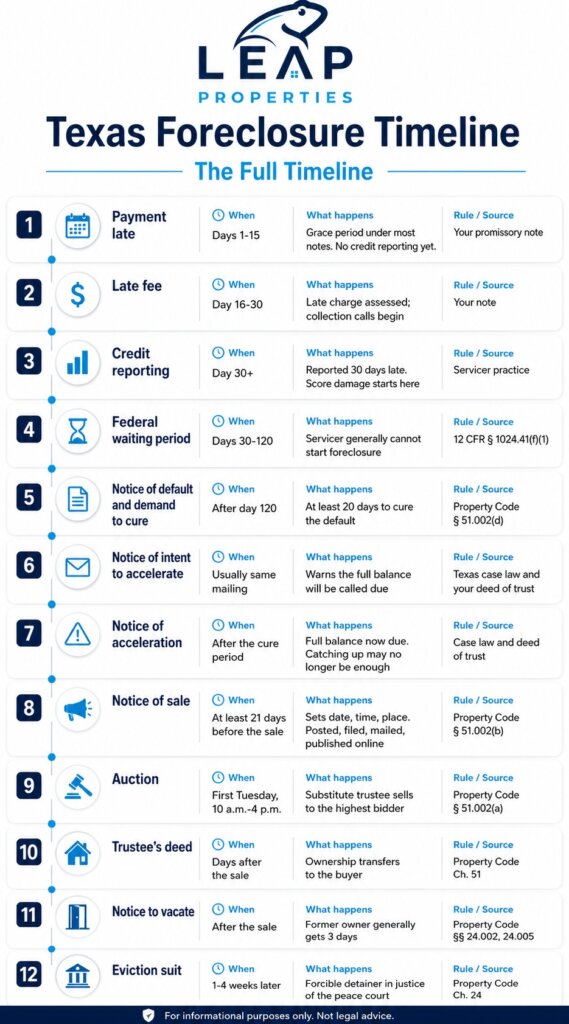
Texas Foreclosure at a Glance: The Full Timeline
| Stage | When | What happens | Where the rule comes from |
| Payment late | Days 1-15 | Grace period under most notes. No credit reporting yet | Your promissory note |
| Late fee | Day 16-30 | Late charge assessed; collection calls begin | Your note |
| Credit reporting | Day 30+ | Reported 30 days late. Score damage starts here | Servicer practice |
| Federal waiting period | Days 30-120 | Servicer generally cannot start foreclosure | 12 CFR § 1024.41(f)(1) |
| Notice of default and demand to cure | After day 120 | At least 20 days to cure the default | Property Code § 51.002(d) |
| Notice of intent to accelerate | Usually same mailing | Warns the full balance will be called due | Texas case law and your deed of trust |
| Notice of acceleration | After the cure period | Full balance now due. Catching up may no longer be enough | Case law and deed of trust |
| Notice of sale | At least 21 days before the sale | Sets date, time, place. Posted, filed, mailed, published online | Property Code § 51.002(b) |
| Auction | First Tuesday, 10 a.m.-4 p.m. | Substitute trustee sells to the highest bidder | Property Code § 51.002(a) |
| Trustee’s deed | Days after the sale | Ownership transfers to the buyer | Property Code Ch. 51 |
| Notice to vacate | After the sale | Former owner generally gets 3 days | Property Code §§ 24.002, 24.005 |
| Eviction suit | 1-4 weeks later | Forcible detainer in justice of the peace court | Property Code Ch. 24 |
Statutory minimums. Most servicers move slower than this, and many take a year or more from the first missed payment. None can legally move much faster.
Days 1-15: The Payment Is Late
Most mortgage notes give a grace period, commonly 15 days. Pay inside it and nothing happens, no late fee, no credit reporting, no letters.
This is the cheapest stage by a wide margin. If you are here and you can cover the payment, cover it.
If you already know next month is also going to be a problem, call the servicer now rather than after they call you. Servicers have far more options available for a borrower who is one payment behind than for one who is four behind, and being early is the only advantage that costs nothing.
Day 16-30: Late Fees and the First Calls
The late charge posts and is typically 4 to 5 percent of the principal and interest portion, set by your note. The automated calls and letters start.
You are still not reported late to the credit bureaus. That happens at 30 days, and it is the first thing in this process that is genuinely hard to undo.
Worth doing now: ask what a repayment plan would look like, and ask whether your loan is owned by Fannie Mae, Freddie Mac, FHA, VA, or a private investor. The answer determines which programs you can access later, and it takes one phone call to find out. You can see more about when it is too late to stop foreclosure.
Day 30-120: Delinquency Reporting and the CFPB Waiting Period
This is the longest stretch in the process, and the most useful.
Under federal regulations, a servicer generally cannot make the first notice or filing for foreclosure until the loan is more than 120 days delinquent, or roughly four missed payments. There are narrow exceptions, such as a violation of a due-on-sale clause or joining another lienholder’s action, but for an ordinary delinquency you have this window.
That protection applies to a mortgage on your principal residence. It does not cover investment property.
One nuance worth knowing: small servicers, basically those handling 5,000 or fewer mortgage loans, are exempt from many requirements, but they are still bound by the 120-day rule.
Meanwhile, the credit damage accumulates. Each 30, 60, 90, and 120-day mark is reported separately, and the missed payments do most of the score damage before a foreclosure ever appears.
What to do with these four months: request a loss mitigation application in writing, submit it complete, and keep copies of everything with dates. A complete application submitted more than 37 days before a scheduled sale generally blocks the servicer from selling while it evaluates you. That is the strongest procedural protection you have, and it only exists if you use it early.
The Notice of Default and Intent to Accelerate (20 Days to Cure)
This is the first formal step, and the first one Texas law controls directly.
Texas Property Code Section 51.002(d) requires the servicer to send written notice by certified mail giving you at least 20 days to cure the default before a notice of sale can be given. It is a floor, not a ceiling, and the servicer can give more and it cannot be waived by agreement.
It applies only where the property is used as your residence. Investment property gets no 20-day cure notice.
In the same envelope you will usually find the notice of intent to accelerate, warning that the entire balance will be called due. That one is not statutory; it comes from Texas case law and your deed of trust. Texas courts have held it has to be unequivocal, and a letter saying the lender “may” accelerate has been held insufficient.
Three things about this notice that matter more than its contents:
- Service is complete on mailing. Section 51.002(e) says certified-mail service is complete when the notice is deposited in the mail. Not when you sign for it. An unclaimed letter still starts the clock.
- Your address is your residence unless you gave the servicer a written change of address. Sections 51.0001 and 51.0021 govern this, and a phone call does not count.
- Read the cure amount carefully. It should be past-due payments plus fees, not the whole loan. If it looks like the full balance, the loan may already be accelerated.
The Notice of Acceleration
Once the cure period expires without payment, the servicer accelerates and declares the full balance immediately due.
This is the moment your position changes materially. Before acceleration, catching up on missed payments cures the default. After it, the servicer can take the position that only a full payoff will do.
Many servicers will still accept reinstatement after acceleration, and Fannie Mae and Freddie Mac guidelines generally encourage it. But you have to ask, and you should get the answer in writing rather than assume.
Texas courts require the acceleration notice to be preceded by a proper notice of intent to accelerate, and both to be clear and unequivocal. If your paperwork looks defective, that is worth an hour with an attorney, but do not build a plan around it.
The 21-Day Notice of Sale
Section 51.002(b) requires notice of sale at least 21 days before the sale date, and it must include a statement of the earliest time the sale will begin.
There is a specific counting rule in Section 51.002(g): the entire calendar day the notice is given counts toward the 21 days, and the entire day of the sale is excluded. That is how you check whether your notice was timely.
Where It Gets Posted and Filed
Four places, not one:
- Posted at the courthouse door of each county where the property sits. This stays at the courthouse door even when the sale itself has been moved to another location.
- Filed with the county clerk of each county.
- Served on you by certified mail at your last known address.
- Published on the county’s website, free and without registration, since a 2023 change to the statute. The county must show the date, time, and location.
There is a weather exception: if the courthouse or clerk’s office is closed for weather, a disaster, or an act of God, posting and filing can happen up to 48 hours after it reopens.
Your notice must also carry a conspicuous warning about rights of active-duty military service members.
How to Find Your Sale Date
If you think a sale may be posted and you did not get the letter, here is where to look in the four Houston-area counties. Be warned that these systems are built for investors, not homeowners, and three of the four are awkward.
| County | Where to look | What to expect |
| Harris | cclerk.hctx.net/Applications/WebSearch/FRCL_R.aspx | Free, no login. Search by document ID, sale month, or filing date only — there is no address or owner-name search. Note: the clerk’s own FAQ links a different URL that no longer works |
| Montgomery | montgomery.tx.publicsearch.us, Department then Foreclosures | One consolidated monthly bundle, hundreds of pages, not indexed by address — you generally cannot find your own house. Better to view the physical file at the County Clerk’s Recording Department, 210 W. Davis Street, Conroe |
| Fort Bend | County clerk’s foreclosure page, monthly PDF lists | The page suggests using Ctrl-F, but the PDFs are scanned images with no searchable text |
| Galveston | County clerk’s property foreclosures page | The best of the four. Individual PDFs named by street address, and they are text-searchable |
If you cannot find your property, call the county clerk. Do not conclude from a failed search that nothing is posted.
Auction Day: The First Tuesday of the Month
Sales are held on the first Tuesday of each month between 10 a.m. and 4 p.m., at the area the county commissioners court designated and recorded.
The sale must begin at the time stated in your notice or no later than three hours after that time. So do not assume 10 a.m. Earliest times of 1:00 p.m. are common. Read your own notice.
One narrow exception: if the first Tuesday falls on January 1 or July 4, the sale is held on the first Wednesday instead. That is the only holiday rule, and some county websites state it incorrectly as a general one. In 2026 neither date fell on a Tuesday.
Where the sales happen locally, verified as of July 2026:
- Harris County: Magnolia South Ballroom, Bayou City Event Center, 9401 Knight Road, Houston. Eight constables sell simultaneously. Cash and certified funds only, and the parking lot fills by 9:30.
- Montgomery County: the steps of the Old 1936 Courthouse, 301 N. Main Street, Conroe, at 10 a.m. Note this is not the Sadler building, which older articles list.
- Fort Bend County: Gus George Law Enforcement Academy, Patton Hall, 1521 Eugene Heimann Circle, Richmond. This changed in December 2025 — the old Fairgrounds address is wrong.
- Galveston County: Galveston County Courthouse, 722 Moody Avenue. The exact spot varies by notice, so read yours.
You do not need to attend, and nothing you say there changes the outcome. Some owners go to learn what the house sold for, which matters if a deficiency claim follows.
After the Sale: Trustee’s Deed and Eviction
The winning bidder receives a trustee’s deed. Sale proceeds go first to the foreclosing lender’s debt and costs, then to junior lienholders in order, then to you if anything remains. At most foreclosure sales, nothing remains.
Then possession. As the former owner you are treated as a tenant at sufferance and the notice to vacate is generally three days. A tenant renting the property is entitled to at least 30 days, and a bona fide tenant on a federally-related mortgage may be entitled to 90 days under federal law, which sets a floor that Texas cannot shorten.
If you stay, the new owner has to file an eviction, a forcible detainer suit in justice of the peace court, which adds a few weeks. Nobody can remove you without a court order and a constable.
Two things people expect that do not exist. There is no right of redemption after a Texas mortgage foreclosure; the sale is final. And there is no requirement that the house sell for what you owed, and if it sells for less, the lender may pursue a deficiency judgment.
One provision homeowners find and misread: Section 51.016 allows a sale to be rescinded within 15 days on six narrow grounds. That is a right belonging to the lender or trustee for sales conducted in error, not a second chance for you.
Judicial vs. Non-Judicial vs. HOA Expedited Foreclosure
Three different processes get called foreclosure in Texas, and they run on different timelines.
| Type | Who uses it | Court involved? | Rough timeline | Redemption |
| Non-judicial | Almost all mortgage lenders | No | About 41 days minimum from the default notice | None |
| Judicial | Rare for mortgages; some liens require it | Yes, a full lawsuit | Many months to years | Varies |
| HOA expedited (Rule 736) | Property owners associations | Yes, but a simplified application | Several months | 180 days |
| Property tax | Taxing units | Yes, a tax suit | Often more than a year | 2 years (homestead) or 180 days |
The distinction matters because your protections differ. In an HOA foreclosure the association must get a court order first, and you get a 180-day redemption period afterward — see how to stop an HOA foreclosure. In a tax foreclosure the timeline is longer and redemption is generous. In a regular mortgage foreclosure you get neither.
How the Timeline Differs by County
The statutory deadlines are identical statewide. What varies is practical.
- How easy it is to confirm a sale is posted. Galveston is genuinely searchable by address. Harris and Montgomery are not.
- How busy the docket is. Harris County runs high volume with eight constables selling at once.
- How fast a post-sale eviction moves, which depends on the justice of the peace precinct.
- Whether tax foreclosures are online or in person. Montgomery County moved delinquent tax sales online, while mortgage trustee sales are still on the courthouse steps. Two different processes, easy to confuse.
None of this changes your deadlines. It changes how hard it is to find out what they are.
Where You Can Still Intervene at Each Stage
| Stage | What still works |
| Days 1-30 | Everything. Pay it, or call and set up a plan while you still have options |
| Days 30-120 | The best window for a modification, forbearance, or repayment plan. Submit a complete loss mitigation application |
| After the 20-day cure notice | Reinstate, modify, short sale, deed in lieu, or sell. Still time for most paths |
| After acceleration | Reinstatement if the servicer agrees, full payoff, or sell. A modification is still possible but tightening |
| After the notice of sale (21 days or less) | Reinstate, pay off, sell to a cash buyer, or file bankruptcy. Modifications and short sales are usually too slow |
| Final 72 hours | Payoff that funds, reinstatement in certified funds, bankruptcy filing, or a trustee postponement |
| After the sale | Nothing that recovers the house. Focus shifts to move-out timing, cash for keys, and any deficiency claim |
The pattern is simple: options that need lender approval need time. Options that need only money or a court filing work late.
Frequently Asked Questions
How long does foreclosure take in Texas?
From the first missed payment, realistically about six months at the fastest. Federal rules generally block the start until you are more than 120 days delinquent, then Texas requires a 20-day cure period followed by a 21-day notice of sale (about 41 days). Many servicers take a year or longer.
How many notices do I get before foreclosure in Texas?
Four legal steps: notice of default with at least 20 days to cure, notice of intent to accelerate, notice of acceleration, and notice of sale at least 21 days out. In practice servicers combine them, so most homeowners receive two envelopes rather than four. That combining is normal and does not make the foreclosure defective.
Is the 20-day and 21-day period at the same time?
No, and this is the most commonly misstated point. The 20-day cure period under Property Code § 51.002(d) must run before the notice of sale is given under § 51.002(b). They are sequential, which makes the minimum runway about 41 days from the formal default notice to the auction.
What is the difference between pre-foreclosure and foreclosure?
Pre-foreclosure is the period after you have defaulted but before the house is sold and you still own it and can still sell, reinstate, or work something out. Foreclosure is the sale itself. Once the trustee’s sale happens you no longer own the property, and Texas gives no right of redemption.
When are foreclosure sales held in Texas?
The first Tuesday of every month, between 10 a.m. and 4 p.m., at a location the county designates. The sale must begin at the time stated in your notice or within three hours after it, so it is not necessarily 10 a.m. If the first Tuesday is January 1 or July 4, the sale moves to the first Wednesday.
Can foreclosure start after just one missed payment?
Generally no. Federal Regulation bars a servicer from making the first notice or filing for foreclosure until the loan is more than 120 days delinquent, for a mortgage on your principal residence. Narrow exceptions exist, and investment property is not covered. But one late payment does not start a foreclosure.
Does foreclosure appear in public records in Texas?
Yes. The notice of sale is posted at the courthouse door, filed with the county clerk, and published on the county’s website. That is how investors get your address and why the mail arrives. It reflects a scheduled sale, not a completed one.
What happens if the notice was sent to the wrong address?
Under § 51.002(e), certified-mail service is complete on mailing, and your last known address is your residence unless you filed a written change of address with the servicer. If notice went to an address you had changed in writing, that may be a real defect so take your documents to a Texas attorney rather than relying on it.
Need to Sell Before Your Sale Date?
If a sale date is posted and you have equity in the house, selling before the auction protects money that would otherwise go to a bidder. We buy across Harris, Montgomery, Fort Bend, and Galveston counties and can close in as little as seven days when title is clean.
If you have more than 45 days and the house is in reasonable condition, you should probably list it instead. A normal sale will typically net you more than we can pay. And if a reinstatement or modification keeps you in the house, do that. A HUD-approved counselor will help you work through it for free at 800-569-4287.
Send us the address and your sale date if you have one. We will tell you what we would pay, what we think you would net listing it, and whether we would try something else in your position. No fee, no obligation, and we stop calling when you tell us to.
Get A Cash Offer For Your House Today!
Fill Out The Form To Get Started!
Deadlines verified July 2026 against Texas Property Code Chapter 51 and 12 CFR § 1024.41; county sale locations verified with the Harris, Montgomery, Fort Bend, and Galveston county clerks. A CFPB rule affecting the federal protections described here is expected in August 2026. This article is general information, not legal advice — consult a licensed Texas attorney about your own notices. LEAP Properties is a Texas home buyer, not a law firm and not a real estate brokerage.
Last updated: July 2026